EN
EN


Read in the article:
What is a bone marrow transplant?
Types of transplantation
Indications for BMT transplantation
Contraindications
Selecting a donor
Cells collection process
Preparation for transplantation
BMT procedure
Recovery after stem cell transplantation
Reviews
WHAT IS BONE MARROW TRANSPLANT?
TYPES OF TRANSPLANTATION
There are several types of transplantation of hematopoietic cells. The simplest is a transplant to patient from his own body cells (autologous bone marrow transplant).
If this type of intervention is not possible, an allogeneic stem cell transplant is prescribed – from the nearest relative or from a donor with an identical phenotype that is not a relative.
INDICATIONS FOR BMT TRANSPLANT
Bone marrow is transplanted for therapy of blood cancer and other blood disorders: lymphomas, leukemias (leukemia), anemia, myeloma, dysplastic syndromes, bone marrow aplasia.
CONTRAINDICATIONS FOR BONE MARROW TRANSPLANT
For Patient: Bone marrow is not transplanted to patients who suffer from serious kidney or liver diseases at the terminal stage. Categorically the procedure is contraindicated for people with infectious diseases and pregnant women. Also, the transplant is not performed in cases where the patient is physically unable to withstand such a procedure.
For the Donor. Candidates with autoimmune, oncological and infectious diseases, as well as mental disorders are not allowed to donate.
SELECTION OF DONOR

Anyone who does not have medical contraindications between the age 18-55 can be part of bone marrow donation process. Candidates take blood tests to determine the phenotype, undergo a general examination for inclusion in the database. In Europe, the largest database is the European Donor Bank, which contains data of over 4 million potential donors from the whole EU. There are also local registers limited to one country. Donor search on a European database takes up to 1 month, search in local databases – 1-2 weeks.
All potential candidates who are in the database donate their bone marrow exclusively for free. Therefore, the candidate can refuse to donate at any time, no later than 10 days before the transplant. Also, a potential donor may be ill at the time of need or absent in the country. In this regard, usually a patient is looking for several donors.
For a transplant from relative, the patient’s brother / sister material is used, provided that the patient is compatible. The bone marrow of one of the parents (Haploidentical bone marrow transplant) is used less often. However, compatibility in this case does not exceed 50%.
CELLS COLLECTION PROCESS
The cells collection process is performed under general anesthesia. The doctor makes a cut in the hip area, and then receives the material with a syringe. Sometimes, hematopoietic stem cells are obtained from peripheral blood. To do this, the donor needs to take drugs for several days, causing hematopoietic bone marrow cells to migrate to the peripheral blood. The donor is connected to a special apparatus for several hours, which drives the blood through the separator. Thus, stem cells are filtered out.
In autologous bone marrow transplant, cells are taken and frozen until the end of chemo session.
PREPARATION: CHEMO SESSION AND RADIOTHERAPY BEFORE TRANSPLANT OF THE BONE MARROW
In cases of blood cancers, the therapy protocol includes high-dose radiotherapy and chemo session. Standard dosages for leukemia are ineffective. Such therapy destroys malignant blood cells and the patient’s bone marrow, freeing up space for new cells to be transplanted. This process is called air conditioning.
In case of autotransplantation, the hematopoietic stem cells are collected first. The affected material and the incompetent cells are separated from the obtained material in laboratory conditions. After conditioning – the bone marrow is again injected to restore the hematopoiesis system.
BMT PROCEDURE
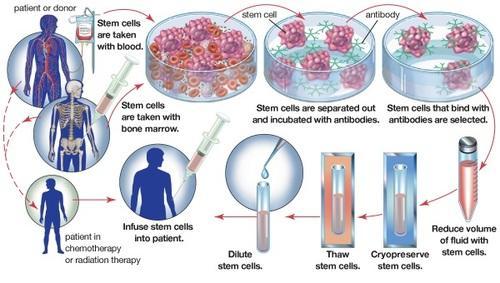
The process of bone marrow transplant to the patient is performed through intravenous transfusion of the material. The intervention does not differ from the usual blood transfusion, does not require anesthesia.
REHABILITATION AFTER BMT TRANSPLANTATION
The most difficult stage is the period of transplant engraftment. Usually it lasts from two weeks to a month. This is a critical period after which you can judge the success of the procedure. The survival of the transplanted material primarily depends on the degree of compatibility of the donor with the recipient.
Patients have difficulties in tolerating this period as there are many side effects:
- nausea & vomiting;
- general weakness & fever;
- bleeding;
- the appearance of ulcers in the oral cavity;
- disorders of the gastrointestinal tract.
All these symptoms have tendency to appear and disappear, which further exhausts the patient.
After transplantation, there is a high risk of graft rejection or a “graft-versus-host” reaction-transplanted cell attacks on the patient’s body. To exclude these complications, the patient is prescribed immunosuppressors – drugs that suppress the immune response of the patient, as well as anti-infective therapy and antibiotics. Since during this period the patient’s body is helpless before infections, that is why patient is placed in a special sterile box. This is a room equipped with a special filter, which prevents the infection. The patient is forbidden to take gifts, food and flowers from loved ones,as this can disrupt the sterile conditions of his stay.
This isolation seriously affects the psyche of an already weakened patient. Therefore it is extremely important not to neglect the help of professional psychologists who work in all oncohematological centers of foreign clinics.
RECOVERY OF CHILDREN

For child to bear such severe consequences of the procedure in isolation is especially difficult. Therefore, foreign clinics try to recreate the most cozy home atmosphere in children’s centers of bone marrow transplantation. Children’s wards have books and game consoles.
LIFE AFTER BONE MARROW TRANSPLANTATION
RECOMMENDATIONS
Within a month after discharge from the hospital, the following recommendations should be adhered to:
- adhere to personal hygiene (wash hands before and after eating / toilet / hygienic procedures, use only personal hygiene items, change clothes and under garments daily);
- wear a mask when in contact with other people;
- do not make contact with sick people, animals and do not change children diapers;
- you can not grow plants in your room, work in the garden;
- you should do an easy daily exercise;
- smoking and drinking alcohol;
- avoid direct sunlight.
Further recommendations will depend on the patient’s state of health by the end of a month after discharge.
RISK OF RECURRENCE
The risk indicator depends on many factors – from the initial diagnosis, the compatibility of the donor, compliance with the recommendations of the doctor and the general health of the patient. The risk of recurrence decreases with passage of time passed since the transplant. Patients who survive the 5-year mark are considered fully cured.
PATIENTS TESTIMONIALS
For me, the diagnosis of leukemia was just like a bolt from the blue. I did not even think that I had a chance with such a diagnosis. Fortunately, my family did not panic, parents on the recommendation turned to the guys from Mediglobus. A month later I flew to Istanbul, especially not hoping for anything good … Turkish doctors so calmly reacted to my diagnosis – I did not even immediately understand what’s wrong .. It turned out that the statistics in the clinic was more than 90% of such patients, as well as I recovered! I was very lucky, my brother was my donor. Many are looking for donors among strangers, but I did not have to. For several months now, I returned home. I will not say how much I had to go through during the treatment, the main thing is that I’m alive! Thanks to my family and Turkish doctors for this.