EN
EN


For women, the diagnosis of uterine fibroids sounds like a sentence. This disease leads to infertility and other adverse effects. But there is no need to panic prematurely. The development of medical technology does not stand still. Modern doctors use effective and safe methods of uterine fibroids treatment to help recover patient and preserve the function of having children in future.
WHAT IS UTERINE FIBROIDS
Fibroids of the uterus is a benign hormone-sensitive neoplasm in the form of nodules. In 95% of cases, the tumor develops in the walls of the uterus, in 5% – on the neck of the organ. The size of uterine fibroid nodules can reach several centimeters in diameter.
Leiomyoma tumor can be single and multiple. Has the feature to quickly spread and reappear even after complete removal.
There are three types of tumors: intermuscular (develops in the inner muscular layers of the uterine wall), submucous (growth of neoplasm is directed to the uterus), subserous (the tumor grows towards the abdominal cavity).
CAUSES AND SYMPTOMS OF UTERINE FIBROIDS

Cause of the disease is a violation of the level of estrogen and progesterone. Morphological changes in myometrium occur, which leads to the appearance of uterine leiomyomas.
Formation of fibroids can be provoked by the: Wrong use of contraceptives, abortion, infections, inflammatory processes and hemodynamic disturbances in the pelvic organs can provoke the formation of fibroids. Women being overweight or with a genetic predisposition are in risk group of developing uterine leiomyomas.
Development of fibroids in the early stages is often asymptomatic. When the first signs appear, the tumor is already large and the woman needs surgery. In the absence of proper treatment, the disease causes infertility or enters a malignant stage.
MAIN SYMPTOMS OF UTERINE FIBROIDS:
- Lower abdominal pain;
- Copious and prolonged menstrual flow;
- Bleeding not related to menstruation;
- Anemia, a decrease in red blood cells count;
- Constipation and difficulty urinating.
DIAGNOSTICS OF UTERINE FIBROIDS IN FOREIGN CLINICS
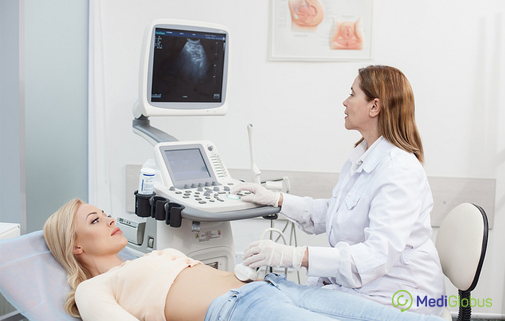
Presence of these symptoms and signs suggest the presence of uterine fibroids. Patient is sent for the diagnosis in the following cases.
If local clinics do not use high-quality diagnostic equipment then there is a risk of faulty diagnoses. Large foreign medical centers and laboratories are equipped with modern highly sensitive diagnostic equipment, which helps to determine the degree of the disease, the type and localization of the tumor with maximum accuracy, which increases the chances of recovery.
If myoma is suspected, doctor prescribes the following diagnostic measures: gynecological examination, ultrasound, MRI, CT, laboratory tests, hysteroscopy. Based on the results of the examination,treatment is determined which can medication based, surgical or combination of both.
MEDICAL TREATMENT OF UTERINE FIBROIDS
Main reason for the development of uterine fibroids is hormonal disturbance, so the task of the doctor is to normalize the hormones that affect tumor growth.
Treatment of uterine fibroids without surgery with drugs is prescribed if the woman is in the pre-climatic period, with fibroids not bigger than 3 cm, slow growth and the absence of severe symptoms, as well as before surgery to reduce the size of the uterine fibroids. In other cases, hormone therapy is ineffective and requires other treatment methods.
Treatment of uterine fibroids with drugs depends on the size of the nodules and symptoms. With myoma following treatment is prescribed:
- Combined oral contraceptives. With nodules up to 1.5 cm to reduce them and relieve pain symptoms.
- Gonadotropin releasing hormone agonists. Ability to decrease the size of the tumor. Drawback of drug is that after the cessation of the course, a relapse is possible. With prolonged use, there is a decrease in the level of estrogen, which causes other undesirable effects. More often, drugs are prescribed before surgery to prevent blood loss.
- Anti-progestagens. Relieve pain in fibroids and reduce the size of these formations. Recommended before surgical treatment.
- Antigonadotropins. Remove the unpleasant symptoms caused by myoma, but has many side effects, therefore are prescribed rarely.
- Progestin. Effective with endometrial hyperplasia.
- Ginestryl (Mifepristone) in the treatment of uterine fibroids. An artificial hormonal drug that blocks the synthesis of progesterone, which affects tumor growth. Most often, the drug is prescribed to reduce the size of uterine fibroid nodules before surgery.
With use of uncontrolled or incorrect hormonal drugs many side effects or complications can develop. Cases were observed when the fibroids decreased during treatment, but after stopping the treatment, the tumor returned to its previous state. Self-prescribing drugs is prohibited, it can lead to undesirable consequences and aggravate the situation.
During treatment of uterine fibroids, it is recommended to stick to a diet for the normalization of metabolic processes, vitamin therapy, normalization of the menstrual cycle, arrest of prolonged bleeding, prevention of anemia.
SURGICAL TREATMENT OF UTERINE LEIOMYOMAS IN FOREIGN CLINICS
Not more than 30 years ago scientists proved that the probability of rebirth of a fibroid into a malignant form is as low as – 2%. Fearing the development of cancer, doctors sent patients to the operating table with the diagnosis with fibroids. Hysterectomy (complete removal of the uterus) was prescribed more frequently, less frequently myomectomy (removal of the tumor with preservation of the uterus). Hysterectomy is still practiced in many developing country while in foreign clinics the removal of the whole uterus is done only in extreme cases. This is a big open surgery, during and after which complications are possible, and the rehabilitation period may be delayed for several months. After such an intervention there can be no talk of having children.
In foreign hospitals, surgery is aimed at preserving the female reproductive organs. Modern technologies and developments allow the use of gentle and effective treatments for uterine and cervical fibroids. This is laparoscopy and myomectomy. During laparoscopic surgery, small incision are made in the lower part of the abdominal cavity (with the Sils method, one puncture is required). The tumor is extracted using an endoscope equipped with a backlight, a camera and micro tools. For hysteromyomectomy (Notes method), access to the myoma is made through the vagina.
Robotic myomectomy is a progressive method of removing uterine fibroids. With robotic laparoscopy, the surgeon makes small punctures in the abdominal cavity, but the tools are controlled by a robot. The procedure requires expensive equipment and trained specialists. Following clinics conduct these method in practice:
- Sourasky (Ichilov), Assuta in Israel;
- Motol University Hospital in the Czech Republic;
- Koc, Medicana, Memorial in Turkey.
- Munich University Hospital in Germany;
Reviews given after treatment of uterine fibroids through laparoscopic and hysteroscopic methods are positive. The postoperative period is without problems, and the body is quickly recovers.
In the treatment of multiple uterine fibroid or fibroids of a larger size, open myomectomy is required. A 10 cm incision is made in the lower abdomen and the tumor is removed with preservation of the organ. Reviews after treatment of uterine fibroids using myomectomy surgery differ. Some women had no problems tolerating the postoperative period, while others had complications.
NON-SURGICAL METHODS OF TREATMENT OF UTERINE MYOMA ABROAD
In the advanced clinics of the world, non-invasive methods are recently becoming popular. They are considered safe and effective for treating uterine fibroids of small sizes. Such procedures require expensive equipment and vast experience of specialists.
Non-invasive leiomyoma treatment technologies include:
- Uterine artery embolization. Through the femoral artery with the help of a catheter, microspheres are placed into the blood vessels that feed the tumor. Access of blood is stopped and the tumor is destroyed. The procedure requires local anesthesia. Recovery lasts 7-10 days. Hospitalization is not required.
- Focused ultrasound ablation (FUS Ablation). The method does not require a surgical intervention on the woman’s body. Patient is placed under the MRI apparatus and the pathological tissues localization is determined with high accuracy. An ultrasound is directed which destroys the tumor. However, nearby healthy tissues are not affected.
Incase of diagnosis with uterine fibroids, contact MedicGlobus. We will give you a free consultation about the cost and treatment options in foreign clinics. Fill out the form below and experts will contact you.