WHAT IS BRAIN TUMOR REMOVAL?
Removal of a benign or malignant neoplasm of the brain is a complex operation, when neurosurgeons remove the tumor from the patient's brain.
IN WHAT DISEASES IS BRAIN TUMOR REMOVED?
Most often, the operation is performed for benign neoplasms - meningiomas. The tumor is also removed for glioma, glioblastoma, astrocytoma. Removal of tumors of the pituitary gland and cranial nerves is possible. A similar operation is carried out in the case when metastases from another organ have penetrated the brain.
INDICATIONS FOR REMOVAL OF BRAIN TUMOR
Surgical removal of the brain growth is the most effective treatment available for the patient. However, it is possible if a number of conditions are met:
 the tumor is small and has clear boundaries;
the neoplasm grows rapidly;
the tumor does not touch vital parts of the brain;
the neoplasm is located in a place accessible to the surgeon;
If one of the conditions is not met, the patient is offered alternative treatments for brain cancer.
DIFFERENCE FROM ALTERNATIVE METHODS
Treatment of brain tumors is possible with chemotherapy, radiotherapy and radiosurgery. Radiation therapy procedures are sometimes performed before or after surgery in order to reduce the tumor and increase the chances of long-term survival.
For brain cancer, chemotherapy is not always effective - for example, it is not prescribed for the treatment of benign neoplasms - in which case, the patient is offered radiotherapy before surgery to reduce the size of the tumor.
If the tumor is malignant and cannot be removed, the doctor prescribes the Gamma Knife radiosurgical procedure.
DIAGNOSTICS OF BRAIN TUMOR
Laboratory tests;
Electroencephalography (EEG);
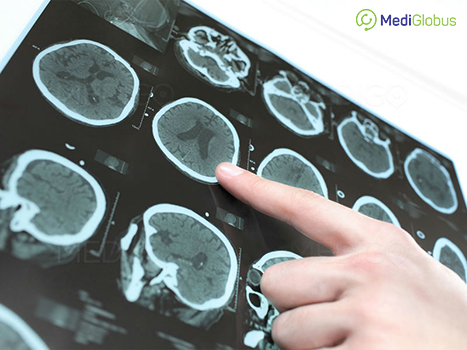
Computed tomography (CT);
Magnetic resonance imaging (MRI);
Since the tumor is located inside the skull, its diagnosis is complicated. For an accurate diagnosis, in addition to CT or MRI, a cytological examination is necessary. All diagnostic procedures are performed on an outpatient basis, except for biopsy. It involves a complex neurosurgical operation, therefore, it is carried out inpatiently. To improve accuracy, the operation is performed by a robot, which is why it is also called stereotaxic biopsy. Oncological diagnosis is made based on the results of diagnostics at a consultation of doctors, which includes oncologists, neurologists, oncological surgeons and neurosurgeons.
HOW IS A BRAIN TUMOR REMOVED?
Craniotomy
Craniotomy is a traditional method of removing cancerous growths. During surgery, the surgeon removes the top of the skull. The patient is under anesthesia, but is sometimes awakened to ask questions to test perception, vision, hearing and memory. Since there are no pain receptors in the brain, it will be painless for the patient. Even large tumors (larger than 4 cm) can be removed with this method, but this reduces accuracy and increases the risk of postoperative complications.
Endoscopic tumor removal
Unlike craniotomy, this is a less traumatic way to remove a tumor. The surgeon makes a small incision in the skull and inserts a camera through it, which gives an overview of the tissue. Thus, he can remove a small tumor. An alternative way is to remove the tumor through the sinuses.
Removal of the tumor under the control of neuronavigation
This is not an independent method - it is used in conjunction with craniotomy or endoscopic removal. Before the operation, the doctor uses MRI to make an individual map of the patient's brain. The neuronavigation system provides the doctor with an overview during the operation. Thanks to this, the movements of the surgeon are accurate to 1 mm - this is comparable to the accuracy of the Da Vinci robot. The risk of postoperative complications due to neuronavigation is minimal. In the Spanish clinic Teknon, the author of the neuronavigation system, Professor Gerardo Conesa, works.
Removal of the tumor under the control of neuromonitoring
The method is used simultaneously with craniotomy or endoscopic tumor removal. The neuromonitoring system analyzes the work of the brain during the operation: measures pressure, blood flow, metabolism. This helps the doctor to understand what area he is currently operating and to avoid possible damage. The most accurate removal of oncological neoplasms is carried out with a neuromonitoring system. It is available at the Oncology Center at the Wiener Privatklinik.
Laser brain tumor removal
Since 2019, Harvard University has been actively developing a method for laser removal of brain tumors. With SRS microscopy, the doctor can see the highlighted cancer cells in real time. This feature makes the method 2 times more accurate than its counterparts. Experts report that the new method will be available in the next few years.
HOW LONG THE OPERATION LASTS?
The operation lasts from 4 to 6 hours as it requires great accuracy and care.
BRAIN TUMOR REMOVAL EFFICIENCY
Surgical removal of the tumor is the most effective treatment for brain cancer. With early treatment, more than 85% of patients survive for 5 years. If the patient comes to the clinic at a late stage, when the tumor is large and cannot be removed surgically, the chances of survival are reduced to 40 %.
Overseas clinics are proud to be able to save patients with glioblastoma. If in clinics of the CIS countries, patients with this diagnosis survive up to six months, then after surgery abroad more than 80 % of patients survive in the next 2 years.
Doctors at the Freiburg Clinic in Germany advise patients to be extremely attentive to your condition after surgery and to re-examine every 6 months to prevent a possible relapse.
REHABILITATION AFTER BRAIN TUMOR REMOVAL
After the operation, the patient is in the intensive care unit from 3 to 5 days. Je or she can leave the clinic in 10-20 days, depending on how the neoplasm was removed.
After the operation, the patient should 2 times a year undergo a physical examination and an MRI. This will help prevent recurrence of the disease in the future.
CONSEQUENCES AFTER BRAIN TUMOR REMOVAL
The sooner the patient seeks treatment, the less pronounced the consequences of the operation. In the early stages of cancer, if the operation took place without complications, the patient can return to an active life. If the tumor has damaged some of the brain functions, the patient should undergo neurological rehabilitation. Since the brain has the ability to compensate and recover, the prognosis for rehabilitation is generally optimistic.
COST OF BRAIN TUMOR REMOVAL
Removal of a brain tumor is an expensive operation due to its complexity. Its cost depends primarily on the type of procedure, and secondly on the class of the clinic, the doctor's experience and the country of conduct. The average cost of an operation is $ 20,000 . The cheapest prices in Turkish clinics are the perfect balance between the competence of surgeons and modern technologies for patients. The cost of the operation in clinics in Europe is higher, but the operation will be performed by famous neurosurgery and oncosurgery with 30 years of experience in practice.
| Country |
Cost |
| Turkey |
from $16,000 |
| Spain |
from €24,000 |
| Israel |
from $28,000 |
| Germany |
from €26,000 |
| South Korea |
from $20,000 |
| Austria |
from €25,000 |
WHICH CLINICS PERFORM BRAIN TUMOR REMOVAL?
Due to the complexity of the operation, it is very important to choose a good clinic with qualified doctors. It should be a multidisciplinary center with departments of oncology, anesthesiology and neurosurgery. The clinic should have modern equipment - the newer it is, the safer the operation.
There is a myth that people with brain tumors cannot fly on airplanes. In fact, it depends on the patient's condition and in most cases flights are safe for patients. If there are contraindications, it is worth choosing a country where you can get an alternative way.
To make the right choice, you can seek consultation at MedicGlobus - we will help you choose a clinic that is best suited for the quality of medical services and budget. According to the MedicGlobus rating, the best clinics for such a neurosurgical operation:
Teknon Medical Center (Barcelona, Spain);
Wiener Privatklinik (Vienna, Austria);
Liv University Hospital (Istanbul, Turkey);
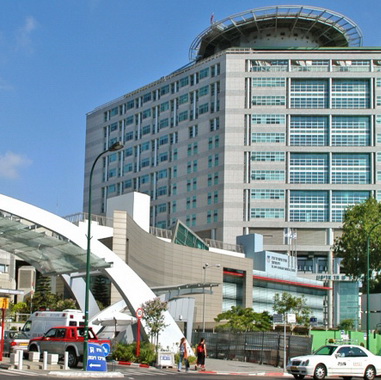
Souraski Medical Center (Tel Aviv, Israel);
Severance Hospital (Seoul, South Korea);
University Hospital of Munich Ludwig Maximilian (Munich, Germany);
Teknon Medical Center
In the Spanish Quirónsalud Group patients are available modern technologies for diagnosis, neuronavigation and operations. As a result, surgeons at the Teknon Medical Center perform the most precise operations compared to other clinics.
Wiener Privatklinik
The Central European Cancer Center has been voted the best in Austria by the Austrian Insurance Association. The center offers innovative cancer treatment methods. Dr. Christoph Cilinski and Dr. Rainer Kotz are respected by colleagues and patients from all over the world.
BRAIN TUMOR REMOVAL REVIEWS
Meningioma was diagnosed in Israel, but doctors refused to operate on her because of a complex case. They decided to contact the Turkish doctors. They gave them all the pictures taken in Israel. They gave me 95% guarantee that my tumor can be removed. After the diagnosis, doctors confirmed what they said. The surgery was a success, and now I feel good!Dmitry, 62 years old
If you need brain diagnosis or treatment from qualified specialists - call MedicGlobus coordinators. Early treatment is the key to a full recovery!
Get a free consultation

 EN
EN