EN
EN


Pancreatic cancer is the number four among causes of death from cancer diseases across the globe. Steve Jobs died in 2011 from pancreatic cancer. To answer the question is pancreatic cancer curable it is important to know about the disease on time and start acting accordingly. To help with this, MedicGlobus has prepared an article on the causes, symptoms and treatment of pancreatic cancer.
READ IN THE ARTICLE:
Pancreatic cancer causes
The risk of developing of pancreatic cancer
The main symptoms of a benign pancreatic tumor
Methods of treatment of pancreatic cancer
Causes of Pancreatic Cancer

The specific cause of pancreatic cancer is difficult to point out like any other cancer type. There are several risk factors, because of which pancreatic cancer can develop. Direct or indirect, independent or combined effects of these factors in general are responsible for causing pancreatic cancer.
WHO IS IN THE RISK OF DEVELOPING PANCREATIC CANCER?
- Group of people with diseases such as diabetes, chronic pancreatitis, cholelithiasis & cirrhosis;
- Group of people with hereditary predisposition: oncological diseases in relatives, mutations of genes (p53, K-ras, BRCA2), Lynch syndrome (hereditary colon cancer without polyposis) etc ;
- Followers of unhealthy diet: oily and spicy food, red meat, excess saturated fatty acids, simple carbohydrates;
- Group of people having alcohol and tobacco abuses (after 20 years of smoking, the risk of developing pancreatic cancer rises 2-3 times);
- Group of people with obesity;
- Men and women after 60-65 years (men are more likely to develop the disease);
- Patients in the precancerous state (with pancreatic adenomas and cysts).
Symptoms of pancreatic cancer
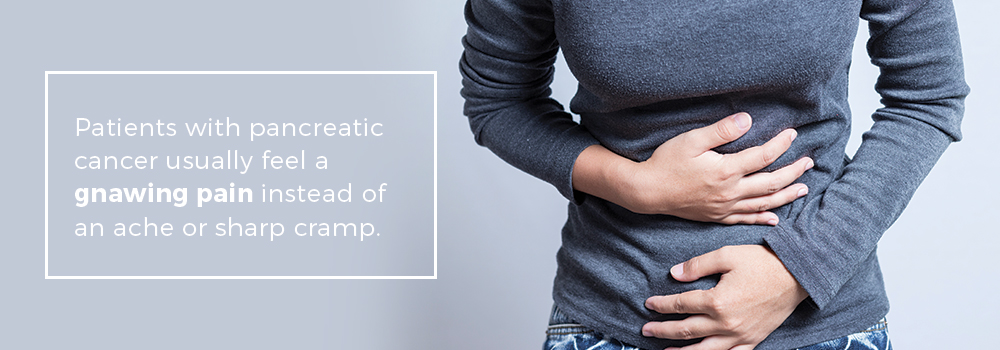
Pancreatic cancer symptoms may not appear until later stages, when serious, expensive treatment is needed. Many patients confuse the early signs of pancreatic cancer with exacerbation of pancreatitis and do not give it attention. This is the time, when cancer is progressing.
THE MAIN SYMPTOMS OF PANCREATIC CANCER ARE:
- Pain: Unpleasant sensations appear when the neoplasm grows into nerve endings. It can hurt in different places: most often under the right rib (tumor on the head of the pancreas), left upper abdomen (tumor on the tail of the pancreas), all-encompassing pain (the whole pancreas is affected). Pain can be felt acutely or as a feeling of discomfort (the intensity may depend on the position of the body). Unpleasant sensations are NOT associated with food intake and can also increase at night.
- Paraneoplastic syndromes: poor appetite, drowsiness, weakness, rejection of fatty foods, a sense of nausea from tobacco and alcohol, weight loss, sleeping problems, etc.
- Thrombosis. Deep vein thrombosis can develop. It is accompanied by pain, swelling, redness and increased skin temperature.
- Mechanical jaundice. Occurs because of squeezing of the bile duct. It is characterized by darkening of urine and skin, a change in the color of the stool to a lighter color. There is also an increase in the abdomen and sensation of itching of the skin.
- Disturbance of digestion: diarrhea, steatorrhea (increased fat components in the stool).
- Constant feeling of heaviness (regardless of the size of the food portion) vomiting occurs when exposed to the duodenum.
- Other signs of pancreatic cancer: blood in the feces, vomiting with blood; with the pressure of neoplasm on the veins of the spleen – its increase in size, anemia, thrombocytopenia, leukopenia; signs of diabetes mellitus; in the late stages – ascites (accumulation of fluid in the abdominal cavity).
MAIN SYMPTOMS OF BENIGN PANCREATIC TUMOR
With a benign pancreatic tumor, there may be similar symptoms: slight pain and weakness. The main difference in the symptoms of malignant pancreatic cancer and benign tumors of the pancreas is the presence of the consequences of intoxication in malignant form (in particular, a sharp weight loss). Symptoms such as jaundice and vomiting can also be present in benign form. This indicates that it has reached to a fairly large size.
METHODS OF TREATMENT OF PANCREAS CANCER

The choice of method for treating pancreatic cancer will depend on the type of pancreatic cancer and whether the tumor is operable or not. As a rule, surgical removal of the neoplasm is possible in 1, 2 stages, less often in 3rd stage pancreatic adenocarcinoma (if large vessels and nerves are not affected).
However, pancreatic cancer treatment option are determined strictly on the results of the diagnostics, which provides information about the localization of the pancreatic tumor and its effect on other organs.
The gold standard procedure for the head of the pancreas cancer is Whipple surgery. During the Whipple procedure, surgical removal of the part of pancreas along a large part of the stomach, duodenum and gallbladder are removed.
Cancerous process might have affected nearby lymph nodes, so they are also subject to resection. This operation is possible with operable cancer type of the head of pancreas for 1, 2 and rarely in 3rd stage.
If malignant neoplasm is localized in the tail of the gland, distal pancreatectomy is performed. The operation consists of resecting the body and tail of the pancreas. If the cancer has affected the spleen, there is a need for resecting spleen too. In addition, resection of the kidney, adrenal gland, diaphragm and other organs can be performed if it is affected by cancerous process.
Other effective method is chemo for pancreatic cancer. It is prescribed before surgery to reduce the size of the tumor, and after – to remove residual cancer cells and reduce the risk of recurrence. Chemotherapy can also be the main method of treatment in the case that the tumor can not be surgically removed.
Modern medicine knows non-surgical methods in pancreatic cancer cure. To provide assistance to patients in 4th stage (inoperable) there is use of the Nano-Knife. This is a unique device that is available in several pancreatic cancer treatment centers around the world: Israeli clinics Sheba and Assuta, as well as the German hospital Helios. In order to perform treatment with Nano knife, the doctor must have a special certificate. Nano-Knife is a non-surgical method of destroying a tumor with a high-voltage current. Thanks to such therapy, the percentage of five-year survival of patients with pancreatic cancer in stage 4 has increased to 16% (from 1%)improving the overall pancreatic cancer prognosis.