
 EN
EN


According to the WHO, prostate cancer is the second most common cancer among men. In 2018, it was diagnosed in 1.3 million people. The main principle of effective treatment for this disease is early diagnosis. Therefore, men are recommended to have regular cancer screening, especially after 45 years. One method of diagnostics is Fusion biopsy, which may soon replace conventional biopsy. You can learn about the benefits of this method and the clinics where Fusion biopsy can be performed from this article.
Prostate cancer is the fourth most common cancer in the world. It kills over 350,000 people every year. When cancer is detected early, the effectiveness of treatment reaches 100%. However, if the tumour has spread through the body by the time therapy begins, this figure drops to 31%.

The problem is that prostate cancer often goes asymptomatic in the early stages. This is why prostate diagnosis is part of the standard check-up package for men.
Increasing in size, the prostate tumour presses on the genitourinary organs. As a result, it causes the following symptoms:
 Pain or burning during urination;
Difficulties with urination;
Frequent night calls to urinate;
Decrease in strength or speed of urine flow;
Blood in urine or semen;
Erectile dysfunction or painful ejaculation.
 Read:
Read: What is fusion biopsy?
Fusion biopsy is a new accurate method of performing a prostate biopsy. Fusion Biopsy combines modern imaging techniques such as MRI and ultrasound to guide the doctor’s movements during tissue extraction.
A prostate biopsy is performed if prostate cancer is suspected. Before prescribing this procedure, the doctor performs a thorough physical examination, analyzes the results of laboratory tests, the patient’s history and complaints.
Fusion biopsy is performed on patients with:
a high level of a prostate-specific antigen (PSA);
negative prostate biopsy results with high or rising levels of the prostate-specific antigen;
positive results of physical examination with negative results of transrectal ultrasound biopsy.
Advantages of Fusion Biopsy over the conventional biopsy
Fusion Biopsy is more accurate. With this method, a prostate tumour can be detected in more than 85% of cases. In comparison, with conventional biopsies, the rate is 40-50%.
Fusion Biopsy is more effective in detecting tumours at 0 or 1 stage. For patients, this means better treatment prospects.
At fusion biopsy tissue samples are taken from 30 areas of the prostate, meanwhile the usual procedure – 12-20.
There’s no need to do a second biopsy.
This method is painless.
The risk of infection or bleeding is reduced for the patient.
A shorter rehabilitation period.
How is Fusion Biopsy done?
The secret to Fusion biopsy is a combination of MRI and ultrasound imaging. During the procedure, the two images are superimposed on each other in real-time. In this way, the specialist is more likely to detect a small tumour.

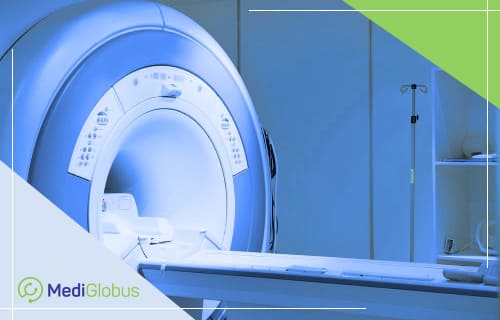
The patient is given a multi-parameter MRI before the Fusion biopsy. With this method, the doctor can examine the physical condition of the prostate in high resolution, as well as assess tissue permeability and blood supply. This procedure is non-invasive, painless and does not expose the body to radiation.
The resulting images are examined by a radiologist and urologist. They discuss which areas could potentially be affected by cancer.
On the day of the Fusion biopsy of the prostate, images obtained during the MRI are uploaded to an ultrasound machine placed in the patient’s rectum. Using special software, the two images are merged into a single 3D model. With this software, the doctor directs the movements of the instrument during the extraction of the prostate tissue.
The fusion biopsy is done on an outpatient basis under general anaesthesia. The procedure takes about 30 minutes. After an hour of rest, the patient can go straight home. For the next 5 days, he should take a course of antibiotics prescribed by the doctor.
In which countries can you do Fusion biopsy?
Fusion Biopsy is a new method used in modern clinics around the world. For this procedure, the patient should go to multidisciplinary or specialised clinics of Spain, Germany, Turkey, South Korea, Austria, that have specialists in diagnostics and treatment of prostate cancer.
 Spain
Spain Turkey
 Germany
 Germany
Urology Hospital Munich-Planegg;
Helios Clinics Group;
South Korea
 South Korea
Soon Chun Hyang Hospital;
Asan Clinic;
Austria
 Austria
Vienna Private Clinic.
Prices of Fusion Biopsies of the prostate
| Страна | Стоимость |
|---|---|
| Turkey | from $3,000 |
| Spain | from €3,000 |
| Germany | from €4,000 |
| South Korea | from $3,500 |
| Austria | from €3,000 |
Resume
Fusion biopsy is a more accurate and safer method of diagnosing prostate cancer.
The accuracy of Fusion Biopsy results exceeds 85%.
The five-year survival rate for prostate cancer in early stages reaches 100%.
Fusion biopsy is available in top clinics of Spain, Germany, Austria, South Korea and Turkey.
If you have questions about Fusion biopsy or are interested in the diagnosis and treatment of prostate cancer, please leave your application on Mediglobus website. Our doctors will answer all your questions and help you organize your treatment.


