
 EN
EN


Proton therapy is a modern alternative to traditional cancer treatment. Compared to radiotherapy, which operates on a similar principle, proton therapy is much safer. This factor is particularly important in the treatment of children, the elderly and sickly people. In the 14 years of the method’s existence, more than 170,000 people have received proton therapy.
Learn more in this article about how proton therapy works and its benefits.
What is proton therapy?
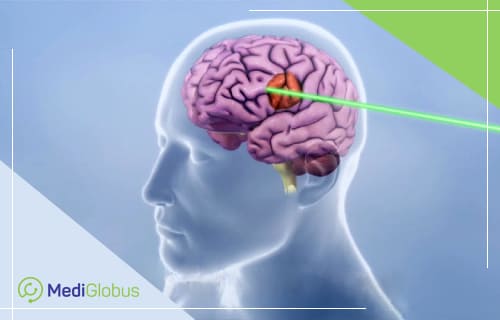
Proton therapy is a method of fighting cancer by destroying tumours with a targeted beam consisting of proton particles.
By its mechanism, proton therapy works in the same way as radiotherapy. The therapeutic radiation has an ionising property. This means that the rays are charged with a large amount of energy, which affects the cells at a microscopic level. This energy causes damage to DNA. Cells with affected DNA lose their ability to divide and multiply. Healthy tissues can repair themselves, but in cancer, that ability is much weaker, so they die. This is why, both in radiotherapy and proton therapy, doctors can destroy the tumour without any incisions. Damage to healthy tissues causes side effects, which go away shortly after treatment concludes when the body starts recovering.
A unique feature that distinguishes proton therapy from other treatment methods is the physical properties of the protons. The ionising radiation they possess is not uniform. Doctors can control it so that the radiation is concentrated only on the tumour, passing through the other tissues almost harmlessly.
This results in more concentrated damage to the tumour and less radiation to the surrounding tissue.
What are the advantages of proton therapy as compared to radiation therapy?
| Precision | On average, proton therapy irradiates healthy tissue by 60% less. The latest generation of devices allows the use of “pencil beam scanning” technology, which further improves the accuracy of the method. |
| Fewer side effects | People undergoing proton therapy experience less pronounced side effects. Depending on the duration of treatment, 2-3 times fewer patients suffer from severe side effects. |
| Efficiency | Although proton therapy is generally as effective at fighting cancer as radiotherapy, there are some cancers for which it is more suitable. These are radio-resistant forms of chordoma, chondrosarcomas and eye melanoma. |
| Better suited for vulnerable patient groups | Children, older persons, patients suffering from comorbid diseases are more susceptible to severe side effects and more difficult to treat. For these groups, greater safety may be crucial in choosing a treatment strategy and may have a significant impact on life expectancy and quality. |
| Reducing the risk of relapse | Radioactive radiation increases the risk of previous cancer returning or new cancer. Children are particularly vulnerable to this effect. In the case of proton therapy, this risk is lower, since healthy tissue is less exposed. |
| Preservation of normal life activity | Because of the lower side effects, patients do not need to change their lives for treatment. They may continue to work, study, do household tasks or hobbies. Loss of ability to perform routine tasks is half as rare as with radiation therapy. |
Who needs proton therapy?
Proton therapy has already shown its effectiveness in the treatment of:
 Brain tumours;
Pituitary cancer;
Eye tumours;
Head and neck tumours;
Spinal tumours;
Oesophageal cancer;
Lung cancer;
Breast cancer;
Liver cancer;
Sarcomas;
Prostate cancer.
Also, studies are being conducted to determine the efficacy of proton therapy in treating pancreatic cancer, lymphoma and melanoma.
The efficiency of Proton Therapy
In most cases, proton therapy is as effective in treating cancer as radiation therapy. The five-year survival rate is not only affected by the treatment method but also the size and stage of the tumour, the presence of metastases, the age and state of the patient, etc. On average, the effectiveness of proton therapy in treating some common cancers is as follows:
Prostate cancer – 76-99%;
Breast cancer – 97.2%;
Lung cancer – 90% for operable form, 58,2% for inoperable form;
Oesophageal cancer – 28,3%-79,3%;
Hepatocellular carcinoma – life expectancy twice as long as after radiation therapy.
What are the disadvantages of proton therapy?
Proton therapy can’t cure all kinds of cancer. During the consultation with an oncologist, the patient will have the opportunity to discuss all treatment options and find out if proton therapy is possible in their case.
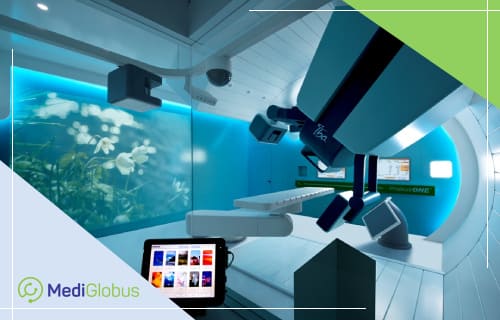
As the equipment used in proton therapy is much more complex in production and maintenance, this method is more expensive. A price/result ratio must be taken into account when making a decision. In some cases, proton and radiotherapy are interchangeable, while in others proton therapy can win priceless months of life.
Preparation for proton therapy
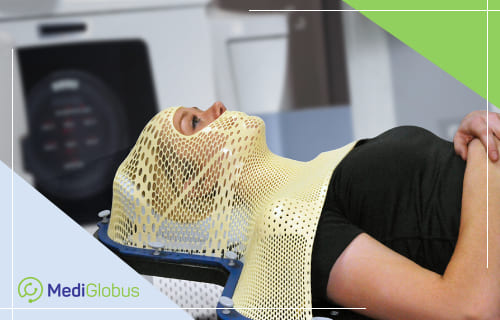
During the first session, the radiology team will spend a lot of time selecting a convenient location for the patient and adjusting the equipment. Doctors will perform MRI or CT scans to clarify the tumour location. The position of the body will be fixed with special cushions or immobilization gear.
In case of head and neck tumours, an individual immobilization mask is created for each patient. It has the shape of a mesh and is made of hypoallergenic plastic, which becomes flexible when warmed up. When the mask is slightly heated in water, a nurse places it on the patient’s face so that it can cool down and fix the head’s position. It is a painless procedure and feels like a spa treatment. The mask is light and does not interfere with breathing.
During therapy, supportive materials can accumulate radiation, so they will be discarded and replaced by new ones.
The nursing staff will mark several guiding points on the patient’s body, with which they will set up the equipment for all subsequent times. The patient can also be photographed so that they can be placed in the same way each time.
Some people, especially patients with a large head and neck tumours, have difficulty lying still for a long time. They can talk to the medical team about this. Doctors can prescribe sedatives to reduce anxiety and make it easier to lay still during the treatment.
Proton therapy in steps
Usually, the course consists of 5 daily visits to the clinic for several weeks. Sometimes doctors only have 1-2 sessions. This is called “radiosurgery”. The principle at work here is “the shorter the course, the more intense the irradiation”.
The procedure can also be different depending on the say. The radiology team may choose to dedicate on day to irradiating the main body or the tumor, and another – on the metastases.
Each session takes 30-45 minutes. Positioning the patient and setting up the equipment takes up most of the time. This ensures the beam’s accuracy. The irradiation itself lasts about a minute.
The patient is placed on a special table. They must be placed exactly the same during each session because that way that the beam can aim correctly. As the session can last up to 45 minutes, the nursing staff ensures the patient’s comfort. Special cushions, mounts and masks are used for this. Before radiation starts, doctors calibrate the equipment and may perform a CT scan to ensure that the patient is in the correct position.
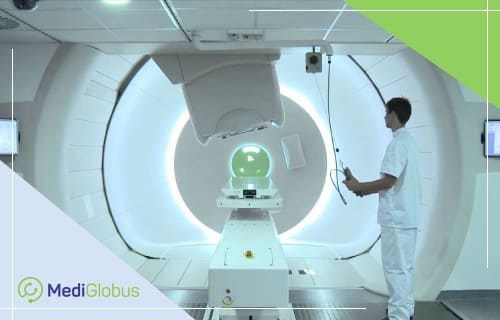
Once the preparation is complete, the doctors will go to the next room and start irradiation. With the help of cameras, they continue to monitor the patient and can always return to the room if necessary. The nursing staff can also be called in at any time with the help of a button.
To ensure the correct procedure, the device is controlled by a network of computers and security systems. They constantly check that the patient and equipment are in the correct position and that the beam is accurately targeted.
Proton therapy is painless and easily tolerated by patients. It does not require hospitalization, and immediately after the session, the patient can return to the normal routine of the day.
What is “pencil beam scan?”
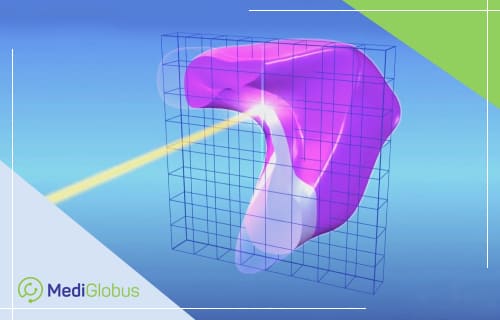
Accelerators of the latest models use so-called “pencil beam scanning” technology. For its implementation, a computer 3D model of the tumour in the patient’s body is used. With a complex magnetic system, a beam as thick as the tip of a pencil scrupulously irradiates the tumour layer by layer. This method is the next step in the evolution of precise and effective proton therapy.
When modelling a tumour, doctors can create up to five fields. They can intersect in places where the malignancy is denser, making it possible to treat irregularly shaped and mobile tumours.
Proton therapy with a pencil beam works best for tumours near the spinal cord or attached to the base of the head, neck or skull, including the nasal and sinus cavities, mouth, salivary glands, tongue, tonsils and larynx.
What are the side effects?
Secondary effects that occur are determined by the cancer’s location. With oesophagal tumours, patients most often complain about digestive disorders, in breast cancer – about heart problems, and prostate cancer – about difficulties with bowel function. More pronounced side effects are to be expected in patients who are undergoing chemotherapy in parallel.
At the same time, proton therapy is easier on patients and has less impact on daily life than other types of cancer treatment. Among the most common side effects are:
weakness;
skin redness around the irradiation zone;
pain around the irradiation zone;
hair loss;
ulcers in the mouth;
difficulties with food intake and digestion.
Price of Proton Therapy Abroad
Proton therapy is more expensive than standard radiation therapy. Besides, not many clinics have the necessary equipment.
In choosing the treatment approach, there are always many factors to consider. For the children, elderly and comorbid people, proton therapy is often the preferable option.
Sometimes, proton therapy can be a cheaper option in long term. For instance, the price of hearing recovery for children with granular blastoma can overweight the price difference of proton therapy.
It is available at:
| PROTON THERAPY |
|---|
| Consultation with an oncologist, radiologist |
| CT and MRI research |
| Side effect control |
| Individual approach |
Quironsalud Hospital Network (Spain);
Proton Therapy Center (Czech Republic);
Carl Gustav Carus University Hospital (Germany);
Samsung Clinic (Korea);
Resume
Proton therapy is a method of fighting cancer by destroying tumours with a targeted beam consisting of proton particles.
It is the best fit for children, the elderly and vulnerable patients.
It is most often used to treat tumours of the head and neck, spinal cord, breast cancer, prostate, liver, lungs, oesophagus, sarcomas, etc.
Proton therapy is more expensive than radiation therapy and is only available in a few clinics around the world. Such centres are available in Spain, Germany, the Czech Republic and South Korea.
To learn more about proton cancer treatment options abroad, click on “Get a free consultation”. Our coordinating physicians will call you back at the number you left and help you choose a clinic and arrange your treatment.


